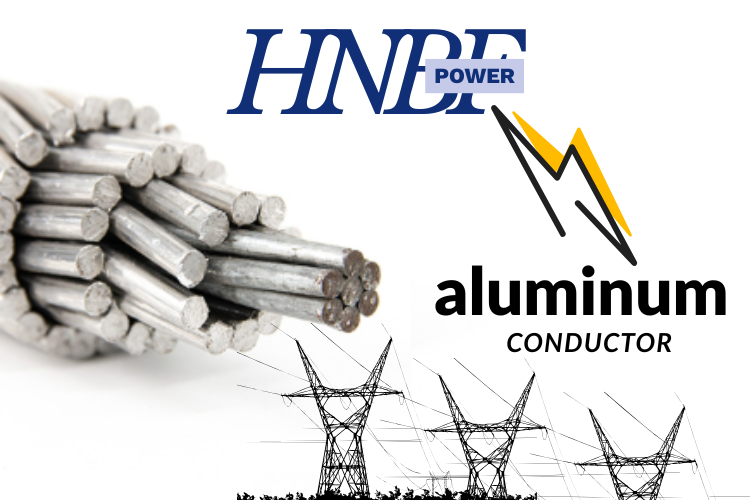
In today’s power transmission and distribution networks, the demand for efficient, lightweight, and cost-effective conductors is higher than ever. The aluminum conductor has become a preferred choice for utilities, EPC contractors, and infrastructure developers due to its excellent balance of performance and economy.
HNBF Power, a global manufacturer of overhead conductors and power cables, delivers advanced aluminum conductor solutions designed to meet international standards and the evolving needs of modern grid systems.
What is an Aluminum Conductor?
An aluminum conductor is an electrical conductor primarily made from aluminum or aluminum alloys, used in overhead transmission and distribution lines. Compared to traditional copper conductors, aluminum offers a lighter weight and lower cost while maintaining strong electrical conductivity.
Key Types of Aluminum Conductors
- AAC (All Aluminum Conductor) – Ideal for short-span distribution networks
- AAAC (All Aluminum Alloy Conductor) – Enhanced strength and corrosion resistance
- ACSR (Aluminum Conductor Steel Reinforced) – High tensile strength for long spans
- ABC (Aerial Bundled Cable) – Insulated solution for urban and compact areas
Each type serves specific applications, ensuring flexibility for different project requirements.
Why Aluminum Conductors Are Preferred in Power Transmission
1. Lightweight and Easy Installation
One of the biggest challenges in large-scale transmission projects is handling heavy materials. Aluminum conductors are significantly lighter than copper, reducing installation complexity and lowering labor and transportation costs.
2. Cost Efficiency for Large Projects
For utilities managing long-distance transmission lines, material cost is a major concern. Aluminum provides a cost-effective alternative without compromising performance, making it ideal for large grid expansion projects.
3. Excellent Conductivity-to-Weight Ratio
Although aluminum has lower conductivity than copper per unit area, its lower density allows for larger cross-sectional areas, resulting in efficient power transmission with minimal losses.
4. Corrosion Resistance
Aluminum naturally forms a protective oxide layer, making it highly resistant to corrosion. This is especially beneficial in coastal, humid, or industrial environments where durability is critical.
Common Challenges and How Aluminum Conductors Solve Them
Power Loss Over Long Distances
Transmission losses can significantly impact efficiency. Aluminum conductors, especially ACSR and AAAC, are engineered to optimize conductivity and reduce line losses over long distances.
Mechanical Strength Requirements
In high-tension lines, mechanical strength is crucial. ACSR conductors incorporate a steel core, providing the strength needed for long spans and harsh environmental conditions.
Urban Infrastructure Constraints
In densely populated areas, safety and space are major concerns. ABC cables offer insulated aluminum conductors, reducing the risk of electrical faults and enabling compact installations.
HNBF Power addresses these challenges by offering customized conductor solutions tailored to specific environmental and operational conditions.
Applications of Aluminum Conductors
Overhead Transmission Lines
Aluminum conductors are widely used in high-voltage and extra-high-voltage transmission systems due to their efficiency and strength.
Distribution Networks
For medium and low-voltage distribution, AAC and AAAC conductors provide reliable and cost-effective solutions.
Renewable Energy Projects
With the rise of solar and wind energy, aluminum conductors play a key role in connecting generation sites to the grid, ensuring stable power delivery.
Industrial and Urban Power Systems
ABC cables are increasingly used in urban areas for safer and more organized power distribution.
Why Choose HNBF Power for Aluminum Conductors?
Advanced Manufacturing Capabilities
HNBF Power utilizes modern production technology and strict quality control processes to ensure consistent performance and compliance with international standards.
Customized Solutions for EPC Projects
Every project has unique requirements. HNBF Power provides tailored conductor designs based on:
- Span length
- Load requirements
- Environmental conditions
- Voltage levels
Global Supply and Technical Support
With experience in international markets, HNBF Power supports utilities and contractors with reliable supply chains and technical expertise.
Focus on Long-Term Performance
Durability and efficiency are at the core of HNBF Power’s product design, ensuring long service life and reduced maintenance costs.
Key Considerations When Selecting Aluminum Conductors
Electrical Requirements
Choose the conductor type based on voltage level, current capacity, and transmission distance.
Environmental Conditions
Consider factors such as temperature, humidity, and exposure to corrosive elements.
Mechanical Strength
Evaluate the required tensile strength for the installation, especially for long-span transmission lines.
Installation and Maintenance
Opt for solutions that simplify installation and minimize long-term maintenance needs.
Working with an experienced manufacturer like HNBF Power ensures that all these factors are properly addressed.
FAQs About Aluminum Conductors
What is the main advantage of aluminum conductors over copper?
Aluminum conductors are lighter and more cost-effective, making them ideal for large-scale transmission and distribution projects.
Which type of aluminum conductor is best for long-distance transmission?
ACSR conductors are commonly used for long-distance transmission due to their high tensile strength and durability.
Are aluminum conductors suitable for urban areas?
Yes, ABC (Aerial Bundled Cable) is specifically designed for urban environments, offering safety and compact installation.
How long do aluminum conductors last?
With proper design and installation, aluminum conductors can last several decades with minimal maintenance.
Can aluminum conductors handle high voltage?
Yes, aluminum conductors are widely used in high-voltage and extra-high-voltage transmission systems worldwide.
Final Thoughts
Aluminum conductors have become the backbone of modern power transmission systems, offering a perfect balance of efficiency, durability, and cost-effectiveness. Whether for overhead transmission, distribution networks, or renewable energy integration, they provide reliable performance across diverse applications.
HNBF Power stands out as a trusted partner for high-quality aluminum conductor solutions, delivering products that meet the technical demands of today’s power infrastructure.
Get Customized Aluminum Conductor Solutions
Looking for reliable and high-performance aluminum conductors for your next project? Contact HNBF Power today to discuss your requirements and get tailored solutions designed for your transmission and distribution needs.
 English
 Arabic
 French
 Spanish
 Portuguese
 Deutsch
 Turkish
 Dutch
Dutch
 Italiano
 Russian
 Romaian
 Portuguese (Brazil)
 Greek
Greek
 Advertise With Us
 About Us
 Terms And Conditions
 Privacy Policy
Mostra tutti i risultati
Privacy Policy
Mostra tutti i risultati